
Skidmore College Social Work Programs
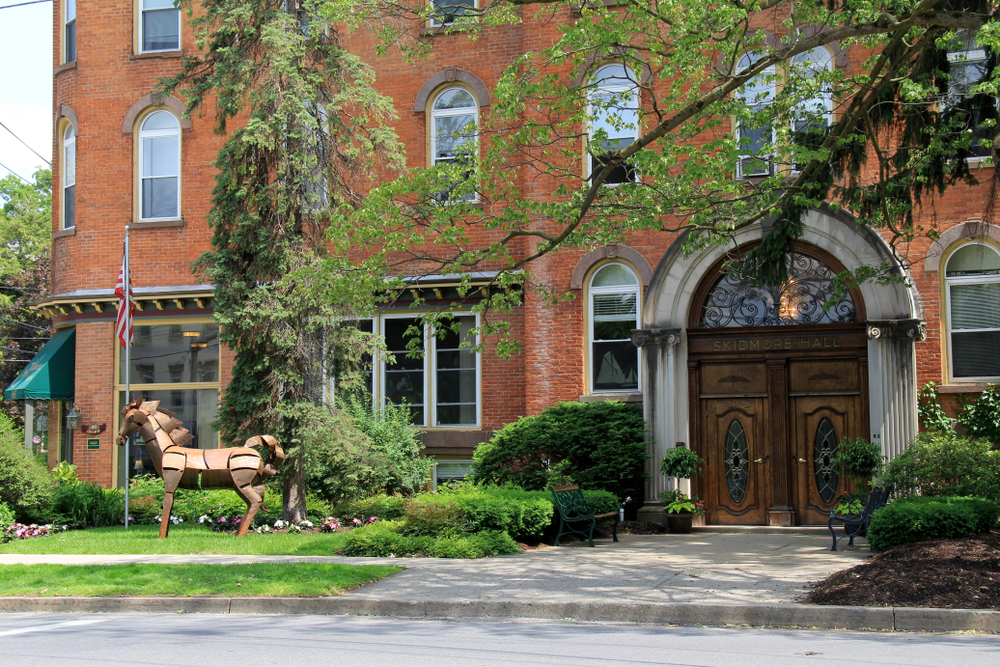
Skidmore College, a private liberal arts institution in Saratoga Springs, New York, has educated students since 1903. This respected academic community blends traditional liberal arts education with professional programs, including its reliable social work offerings.
Beautiful grounds spread across 1,000 acres create a peaceful learning environment for students. Skidmore’s unique “Creative Thought Matters” philosophy sets it apart from other schools. Students learn to think innovatively and apply their knowledge to life situations.
Students who choose Skidmore’s social work programs find an educational experience rooted in interdisciplinary learning. The college’s 8:1 student-to-faculty ratio ensures individual attention throughout their academic trip. Social work students benefit from close mentorship during field placements and research projects.
Skidmore promotes a vibrant community life through more than 100 student-led organizations. These activities help students develop leadership skills they’ll need as future social workers. The college’s steadfast dedication to diversity and inclusion prepares students to work with different populations in their careers.
Saratoga Springs’ location adds value to social work education at Skidmore. This charming small town sits close to major urban centers, giving students access to practicum settings in rural community services and metropolitan agencies.
Students who pick Skidmore’s social work major tap into a strong alumni network that opens doors to internships and jobs after graduation. Many graduates land positions with prominent organizations or advance to graduate programs at top universities.
Skidmore’s focus on hands-on learning lines up with social work education’s vital need for practical experience. Students apply classroom theories to ground situations and build skills that today’s human services employers want.
Social work programs offered
Skidmore College’s social work program has been fully accredited by the Council on Social Work Education (CSWE) since 1983. This 40-year old program offers a Bachelor of Science degree with a curriculum that has two main goals: to prepare you for entry-level generalist social work practice and to build a strong foundation for graduate study.
The social work major needs you to complete ten courses that add up to 44 credits. The core curriculum has:
- SW 212: Power, Privilege and Oppression (4 credits)
- SW 222: Introduction to Social Work and Social Welfare (3 credits)
- SW 241: Research Methods for Social Justice (4 credits)
- SW 253: Human Behavior and the Social Environment (4 credits)
- SW 333: Social Work Practice With Individuals and Families (4 credits)
- SW 334: Social Work Practice With Groups, Organizations, and Communities (4 credits)
- SW 338: Social Policy and Social Justice (4 credits)
- SW 340: Field Preparation Seminar (1 credit)
- SW 381: Social Work Field Practicum Seminar and Senior Coda (4 credits)
- SW 382: Social Work Field Practicum (12 credits)
Your senior year’s spring semester ends with a detailed field experience. You’ll work as a beginning social worker four days each week and complete a minimum of 400 hours over the semester. This hands-on experience lets you apply classroom knowledge in real-life settings while agency field instructors supervise your work.
The program’s success shows in its numbers. About 25% of social work majors get funded internship awards during their time at Skidmore. The department’s study abroad program is thriving – over 75% of social work majors have studied in countries like Denmark, Thailand, Spain, Italy, and England.
Students need to apply for admission during their sophomore year. The selection looks at your academic performance, your commitment to follow the profession’s code of ethics, and how well-suited you are for professional practice[63]. The program’s graduates excel in further education – they are four times more likely to join graduate programs right after graduation compared to other Skidmore students.
Online program options
Skidmore College’s social work bachelor’s degree program doesn’t include any online options. Students need to complete their coursework and field experiences through traditional on-campus classes.
But Skidmore’s University Without Walls (UWW) program offers different distance learning possibilities. This adaptable program serves around 280 full- and part-time bachelor’s students from Saratoga Springs to international locations in Europe, Africa, and Asia. Students don’t need to be physically present on campus.
The UWW program lets students earn their bachelor’s degree completely online, thanks to support from an Alfred P. Sloan Foundation grant. Students and advisors stay connected through telephone, mail, and email for independent study. The UWW program doesn’t offer a social work focus, but students can choose from several interdisciplinary paths, including:
- American History and Culture
- Communication and the Arts
- Human Nature and Behavior
UWW degrees need 120 credits. Students typically complete at least 12 credits in humanities, 6 credits in history, 12 credits in social sciences, and 9 credits in math or science with lab work.
Students who want to study social work at Skidmore will need to take the on-campus program. In spite of that, UWW’s flexible approach might interest students looking for related interdisciplinary studies they can complete remotely. The program’s personal advising system helps create an educational plan that matches each student’s goals while meeting Skidmore College’s academic standards.
Admissions
Getting into Skidmore’s social work major follows a clear path with specific requirements. Students must submit their applications by the spring deadline of their sophomore year. You’ll need to complete or enroll in SW 241 (Research for the Human Services) before applying. The program also requires successful completion of either SW 222 (Introduction to Social Work) or SW 212 (Social Work Values and Populations-at-Risk). Students who finish SW 253 (Human Behavior and the Social Environment) before applying have a distinct advantage.
Your application package should include a completed application form, an admission essay that outlines your career goals and how they match with social work values, and two copies of a declaration of major form. You’ll also need a reference letter from someone who can speak about your potential as a social worker. This reference cannot come from a Skidmore Social Work faculty member.
The selection process looks at three main areas: your academic record, your commitment to following the NASW Code of Ethics, and how well-suited you are for professional practice. The program accepts almost all qualified candidates, though some might start with specific conditions for improvement.
The department reviews transfer student applications individually. Students planning to study abroad should reach out to the department chair early to get proper guidance for their academic journey.
Tuition
Planning your social work education costs at Skidmore College needs careful consideration. The 2025-2026 academic year comes with tuition and required fees of $70,580. Housing costs depend on your choice of room. A traditional double room costs $11,130, while a single room costs $11,730. The unlimited meal plan adds $7,690 each year.
The total cost adds up to about $92,340 with books, supplies, and personal expenses. Skidmore stands among the top 5% most expensive private colleges in the country.
The good news is that Skidmore meets 100% of your financial need. More than half the students get some type of financial support. The average aid package comes to $59,750. The college gives out about $75 million in financial aid every year.
Students whose families earn less than $30,000 pay about $10,280 yearly. Those from families earning over $110,000 pay around $46,892.
Financial aid options include:
- Skidmore grants and scholarships
- Federal programs like Pell Grants (up to $7,395 yearly)
- Work-study opportunities (typically $2,600 annually)
- Federal Direct Student Loans
Skidmore’s monthly payment plan helps spread your costs throughout the academic year. New students should plan for a one-time $150 records fee. Tuition insurance costs $332 each semester.
Other information
Skidmore social work graduates build successful careers in a variety of employment sectors. Their success shows in the numbers – 91% find jobs or continue their education within a year after graduating. Many graduates work in education, business administration, and human services.
Employers consistently praise Skidmore social work graduates. Their testimonials speak volumes:
- “We love hiring Skidmore students… They are curious, sharp, and intellectually engaged.” – AlphaSights
- “The Skidmore graduate we hired was an outstanding employee… her rapport with children and families was remarkable.” – Warren Washington CARE Center
The program’s strong field component helps prepare job-ready graduates. Senior year students work 30-32 hours weekly under professional supervision, completing 425-450 hours of field practicum. This hands-on experience builds the skills employers look for.
Students can earn departmental honors through academic excellence. The requirements include a 3.0 overall GPA and 3.5 major GPA to qualify for honors in research, practice, or overall achievement.
Skidmore’s social work faculty bring their ground experience into the classroom. Professor June Paul worked in public child welfare and education for nearly 17 years before starting her academic career. This practical knowledge adds real-life context to classroom learning.
Recent data shows impressive internship participation. 75% of students complete at least one internship before they graduate, while 72% do two or more. The value is clear – 86% of students say their internships were “very helpful” or “helpful” in preparing them for their careers.